
Lynwood City Directory Shelves
The verified Lynwood city directory collection is not one unbroken annual run. It changes publisher, format, geography, and inclusion rules. The LA County Library Californiana inventory is the strongest local shelf for Lynwood-specific reverse volumes. LAPL adds a large Los Angeles-area digital and physical collection, but its reverse books focus mainly on Los Angeles city territory and only sometimes include independent county cities.
The coverage chart separates a name directory from a criss-cross or phone directory. Years marked partial must stay marked partial.
| Collection | Years or run | Where held | Access and scope |
|---|---|---|---|
| Bell telephone directory | 1931 | LA County Library Californiana, Norwalk | Microfilm; Lynwood-specific inventory entry |
| Greater Los Angeles business directory | 1952 | LA County Library Californiana, Norwalk | Physical volume; Lynwood entry in inventory |
| Haines South Suburban criss-cross | 1981 partial, 1983 partial, 1984 to 1986, 1988 | LA County Library Californiana | Address-to-name reverse reference |
| Haines South Central criss-cross | 1989 to 1992 | LA County Library Californiana | Physical reverse directories with Lynwood listed |
| Pacific Bell Midcities | August 1988 to August 1992, selected issues | LA County Library Californiana | Address and telephone directory |
| LAPL ResCarta city and street sets | 1873 to 1970; reverse years selected through 1987 | LAPL digital collection | Free scans; Lynwood presence must be checked per title |
The collection is useful because different books answer different questions. A surname directory can move from person to address. A criss-cross volume can move from address to listed person. A phone book reflects subscribers. None is a complete current resident list.
Lynwood City Directory Years
The local chronology begins with Bell’s 1931 microfilm, passes through the 1952 Greater Los Angeles business directory, then becomes most precise for Lynwood in the Haines reverse shelf from 1981 to 1992. Pacific Bell Midcities volumes extend the address and phone trail into the 1990s, while yellow and white page inventories continue in Midcities and South Bay products through 2009.
That sequence is a comparison point, not a promise that each year contains every Lynwood address. The Haines 1981 and 1983 records explicitly say coverage is partial. A missing name can reflect an unlisted number, a non-subscriber, an omitted area, a changed publisher, or a gap in the shelf.
| Period | Best question to ask |
|---|---|
| 1931 | Was a name or telephone subscriber recorded on Bell microfilm? |
| 1952 | Does the Greater Los Angeles business directory connect a person or firm to Lynwood? |
| 1981 to 1992 | Who was listed at a street and number in the Haines criss-cross shelf? |
| 1988 to 2009 | What subscriber, phone, yellow-page, or white-page trace survives in Pacific Bell products? |
Use the exact year as a time stamp. Do not blend a directory entry, a deed, and a modern parcel card into one timeless claim.
Reading a Lynwood City Directory Entry
A typical name-directory entry can include a surname-sorted person, spouse, occupation, residential address, and sometimes a telephone number. LAPL’s guide says residential addresses may carry an `h` prefix for householder or an `r` prefix for resides. Reverse volumes invert the path and arrange the material by street, number, and listed subscriber or resident.
The field inventory below describes documented conventions without inventing a verbatim Lynwood page. The research session did not expose a fully readable Lynwood sample entry.
| Entry clue | How to read it |
|---|---|
| Name | Search surname first, then initials, middle names, and surname variants. |
| Spouse | A relationship clue; verify the volume’s abbreviation key before expanding it. |
| Occupation | A same-person clue that can separate two people with the same name. |
| Address | Physical location as printed, with householder or resident notation where used. |
| Telephone | Subscriber evidence, not proof of ownership or every occupant. |
| Reverse order | Street and number first, then a listed name or subscriber. |
- Criss-cross directory
- A reverse directory arranged by street and number rather than surname.
- Householder index
- A name or address notation that points to the person treated as the main household contact in that volume.
- Abbreviation key
- The publisher’s explanation of short forms such as `h`, `r`, occupations, and street names.
A directory entry is an historical snapshot. It may show a listed person, spouse, occupation, or business connection, but not all household members or later moves.
Lynwood City Directory OCR Traps
The free LAPL ResCarta interface offers Browse Collections, Browse Titles, Simple Search, and Help modes. Its inspection reported 184 digitized titles. LAPL says the historic collection covers city, business, and phone directories from 1873 to 1970, with street or reverse sets in selected years from 1906 through 1987. The broader collection description runs from 1875 through 1987, so the title-level date matters.
OCR makes a plain address search unreliable. LAPL’s own example says `h443 N Av 52` may work when bare `443 N Av 52` does not. Numbered streets can be filed before, after, or within named streets. `Avenue Sixty-Four` may not match `Ave 64`, and `Broadway` may appear as `Bway`.
Try a surname, a street variant, and the likely notation. Browse the title when Simple Search fails. Then check whether the volume actually includes Lynwood rather than assuming a Los Angeles reverse run covers the independent city.
For a visual reference, the LAPL ResCarta collections browser shows the browse and search modes.
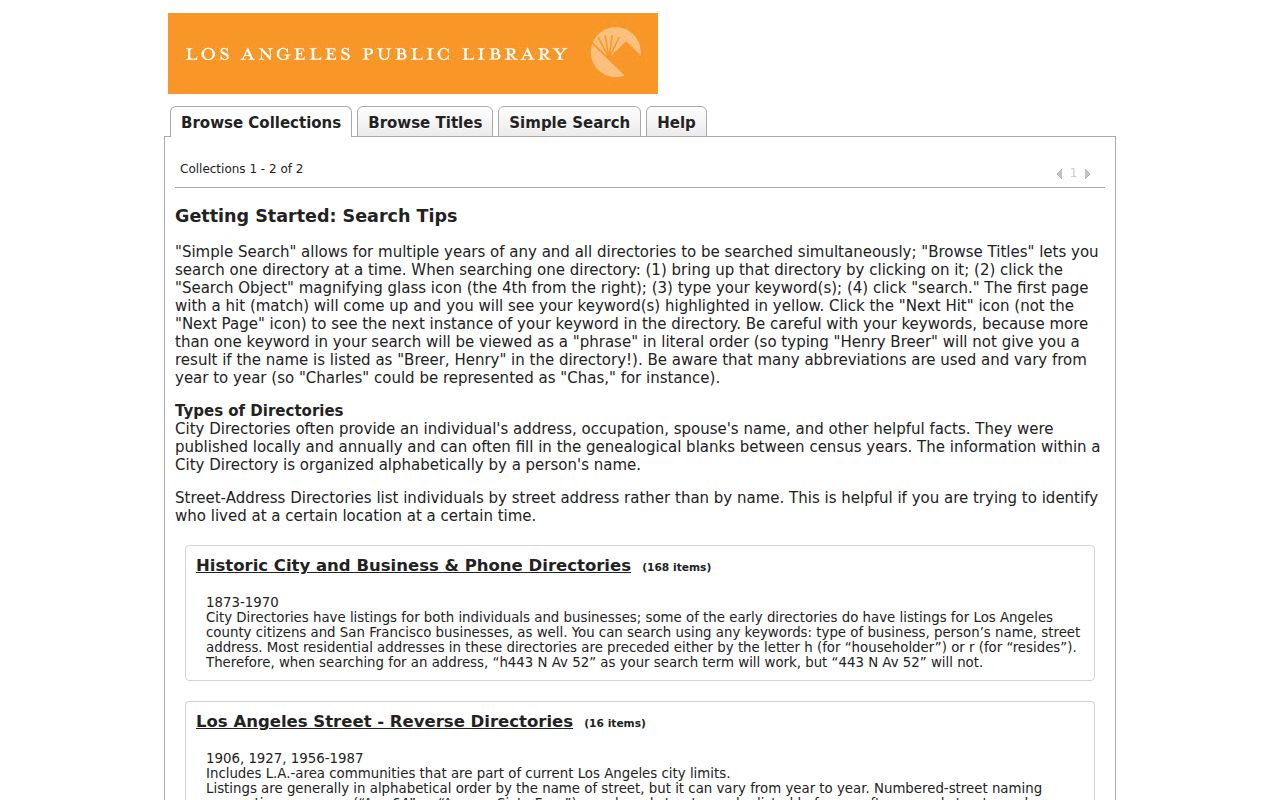
The search tool is broad, but the Lynwood hit still needs a title, page, year, and coverage check.
The LAPL digitized directory index adds the collection-level date and title context needed before opening a scan.
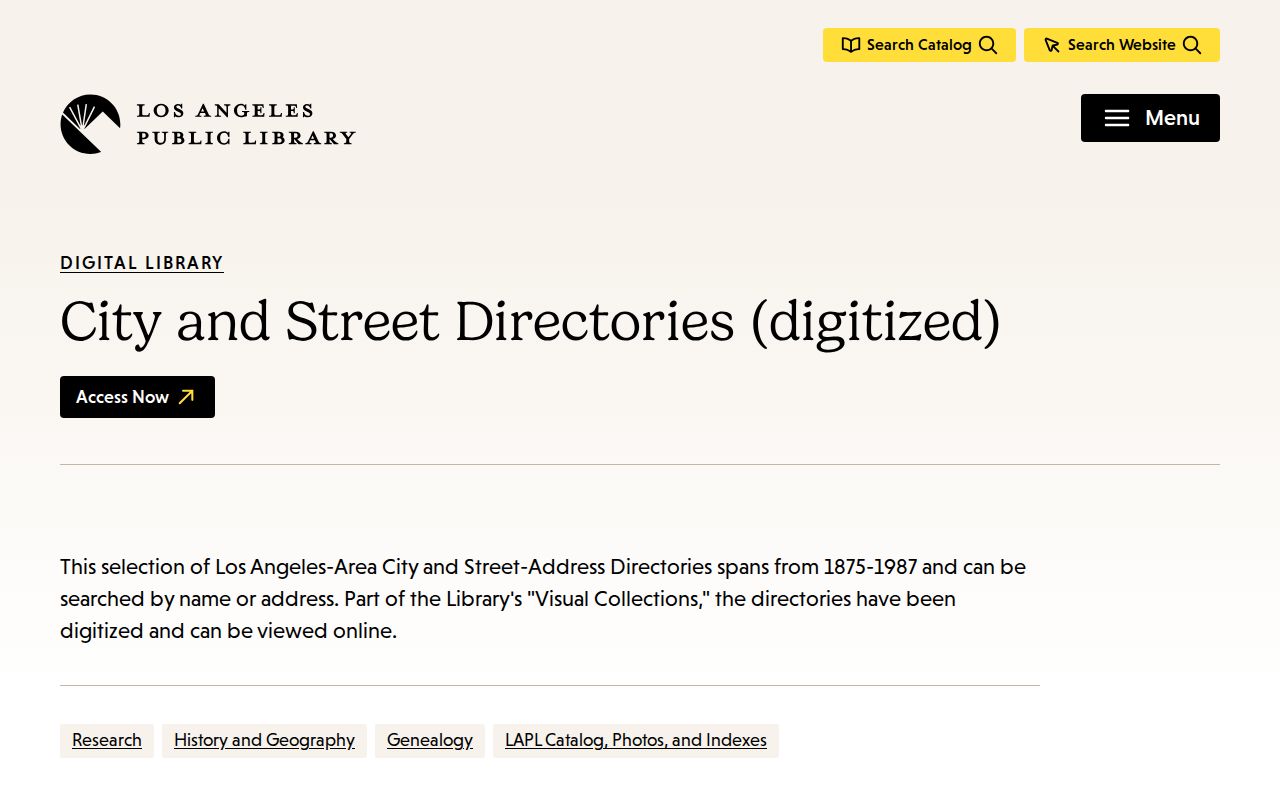
A collection landing page can describe a broad run; the individual volume still decides whether Lynwood appears.
Lynwood City Directories in Haines
For an address in the 1980s or early 1990s, the LA County Library’s Haines shelf is the insider route. The inventory names South Suburban volumes for 1981, 1983 to 1986, and 1988, then South Central volumes for 1989 to 1992. It specifically lists Lynwood and flags partial coverage in 1981 and 1983.
Begin with the street spelling as printed, then test a shortened Boulevard or Avenue form. Record the house number, listed name, telephone when present, and the exact volume. A disappearance is not proof of a move or death. It can mean the number was unlisted, the title omitted a portion of Lynwood, or the publisher changed its coverage.
Haines is stronger for the address-to-name question than a Los Angeles-city reverse book whose independent-city coverage is intermittent. The physical shelf is closed-stack material, so contact the Norwalk library staff before assuming a volume is available for walk-in browsing.
Trace Lynwood City Directory Households
A household trail needs several dates. Start with a known directory year, normalize the street spelling, and compare the same address in the prior and next available volume. Then switch to surname order when the family moves. Occupation, spouse, middle initial, and the address together are better identity anchors than a common surname.
Pair the printed record with census and property evidence. The newest publicly released decennial census is 1950 under the 72-year rule. City directories can help locate people in a census year, while deeds identify title and permits date physical work. Those roles should remain distinct.
- Choose a directory year and copy the exact name, address, spouse, occupation, and any notation.
- Search the nearest earlier and later available directory, including spelling and abbreviation variants.
- Pair the address with the 1930, 1940, or 1950 census where the enumeration district and place align.
- Check a deed, parcel, permit, or tax record for the property role rather than calling the directory entry an owner.
- Use a newspaper, obituary, or probate file to close a deceased person’s trail, with identity cross-checks.
For current parcel work, move to the Lynwood by street records page. A historical directory should not be forced to answer a modern address question it was never designed to answer.
Lynwood Library Directory History
The local branch’s own address history is a record clue. Lynwood Express Library began in May 1915 as a volunteer library, soon joined the Los Angeles County Public Library system, and moved from a clubhouse room on Long Beach Boulevard to a storeroom at Long Beach Boulevard and Fernwood Avenue in 1917. It occupied Elmwood Avenue from 1918 to 1924, an old Sanborn Avenue building from 1924 to 1956, a Civic Center structure from 1956, and the present location from 1977, refurbished in 2004.
That sequence helps date photographs, civic notices, directory entries, and newspaper items. The branch at 3798 Martin Luther King Jr. Boulevard offers research assistance, an online catalog, databases, photocopying, public computers, and email-a-librarian support.
For a visual reference, the City of Lynwood Archive Center shows the kind of municipal document trail that can preserve names and places when a directory is not in print.
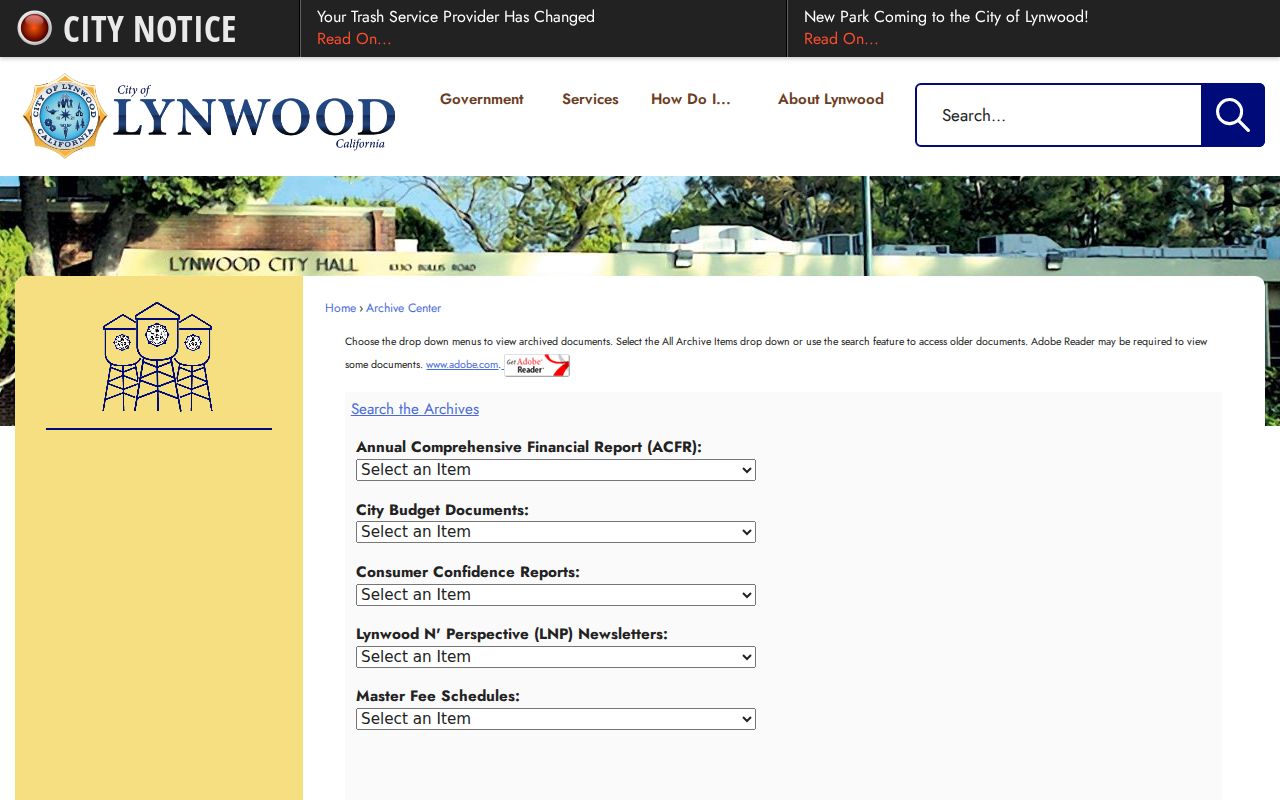
Archive documents can place a person in a civic role or date an address, but they are not a complete resident roll.
Lynwood Directory Newspapers
Newspapers add family and community context that a printed volume does not. The Lynwood branch names the Los Angeles Times, LA Watts Times, Long Beach Press-Telegram, and Los Angeles Wave. LAPL’s historical guide also names the California Eagle, Daily News, Evening Post-Record, and Los Angeles Evening or Hollywood Citizen News in its broader holdings.
Search a surname with a street, spouse, school, church, business, or organization. A notice may appear in a regional paper rather than one carrying Lynwood in its title. Obituaries can connect relatives, former addresses, occupations, and dates, but LAPL cautions that not every metropolitan resident received one.
A probate case, death certificate, or deed can test an obituary clue. The newspaper is a lead and a narrative source, not a certified vital record.
Lynwood Directory Coverage Gap
LAPL holds more than 5,000 microfilm rolls, about 1,000 hard-copy U.S. directories, and a large genealogy collection. Its ResCarta browser reported 184 digitized directory titles. Size does not equal local coverage. The independent-city boundary is the recurring gap: a Los Angeles city reverse volume may not include Lynwood, while a county-library Haines volume explicitly does.
Sanborn maps create a related caution. The Library of Congress offers a Los Angeles atlas finder for volumes from 1890 to 1970, but no standalone Lynwood edition or year was verified in the research. Sanborn sheets show building footprints, materials, use, doors, windows, and dimensions. They are structural evidence, not people lists.
Use the catalog title, exact year, city or community field, and physical shelf note. If a collection description is broad, inspect the volume before treating it as Lynwood evidence.
For a visual reference, the LAPL genealogy guide explains the larger physical and digital collection behind local directory research.
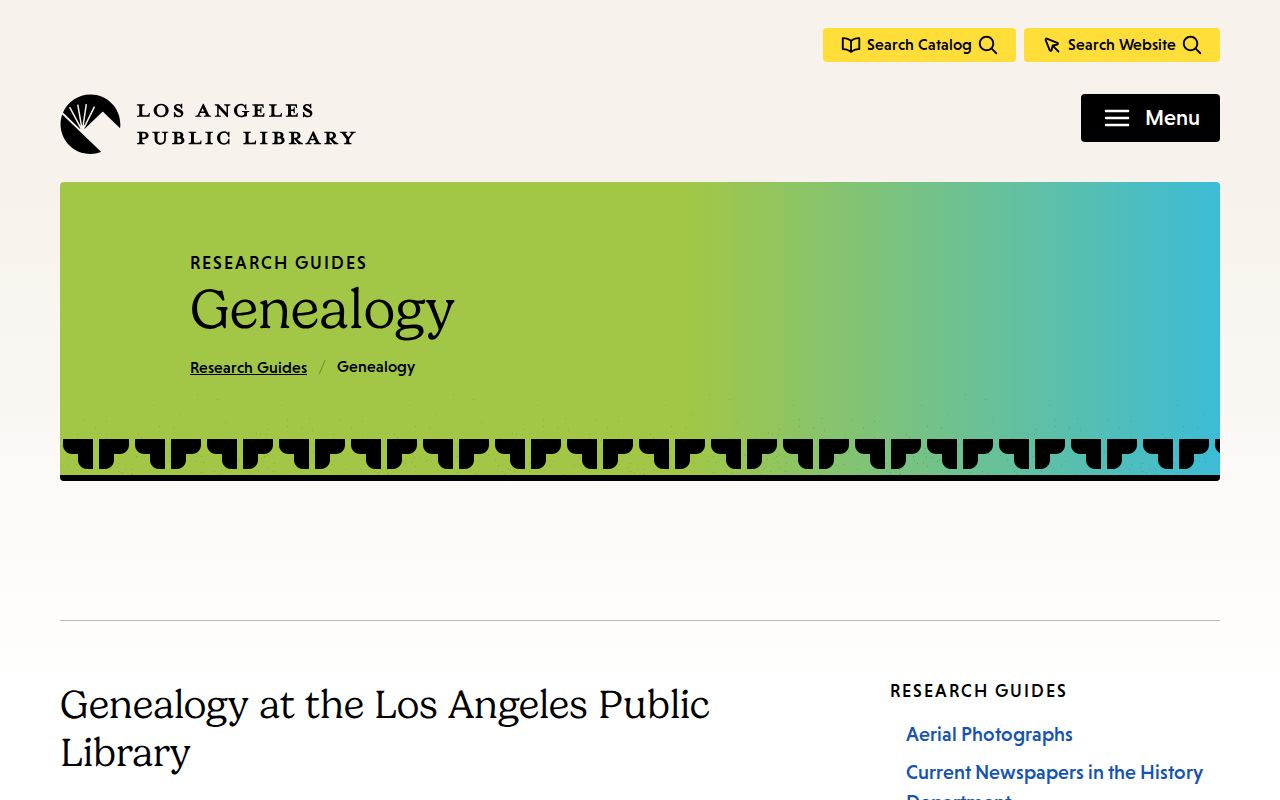
A careful city directory search treats a collection’s boundary as a fact to verify, not a detail to assume.
Lynwood City Directory Comparisons
The historical directory trail changes shape across the years. Comparing products keeps a single listing from carrying more weight than it deserves.
| Product | Starts with | Likely evidence | Main limit |
|---|---|---|---|
| Name directory | Surname | Address, spouse, occupation, sometimes phone | May omit non-listed people |
| Haines criss-cross | Street and number | Listed subscriber or resident at an address | Partial years and area gaps |
| Bell or Pacific Bell phone book | Name or number | Telephone subscriber and contact listing | Subscriber is not necessarily owner or occupant |
| City archive or newspaper | Keyword, date, or story | Civic role, event, organization, obituary | Not a systematic resident index |
That comparison is why the phrase city directory should mean a dated source with a known publisher and scope. For a current person question, use a separate Lynwood resident lookup workflow and verify the record with the named custodian.